Safety
The crib, stroller and car seat checks that are written down
Slat spacing, corner post height, mesh size, the stroller standard and the back-seat rule: the baby gear checks with a published number behind them.

Most baby gear advice circulates as folklore. A small part of it is written down with numbers attached, published by the Consumer Product Safety Commission and the Centers for Disease Control and Prevention, and that part is short enough to read in one sitting.
This guide collects those published figures and says where each one comes from. It is not a substitute for the instruction manual that came with your own equipment, and it contains no test results, because we have not tested anything.
The five crib measurements
The Consumer Product Safety Commission's crib safety guidance gives numbers rather than adjectives. Slats must be no more than 2 3/8 inches apart, which it describes as about the width of a soda can, so that a baby's body cannot fit through them. Corner posts must be no more than 1/16 inch high, so that clothing cannot catch on them. There must be no cutouts in the headboard or footboard, because a head can be trapped in one.
The mattress requirement is a fit rather than a dimension: firm and tight-fitting, so that a baby cannot become trapped between the mattress and the crib side. For mesh-sided products the mesh must be less than 1/4 inch, which the guidance compares to the size of the small buttons on baby clothing.
The older federal requirements that set the pattern are still worth reading for context. A CPSC news release on the full-size crib standard states a maximum of 2 3/8 inches between slats and a rail height of 26 inches from the top of the railing to the mattress support at its lowest level, and records that cribs introduced into interstate commerce after January 31, 1974 had to meet the regulations.
| Measurement | Published figure | What it is for |
|---|---|---|
| Space between slats | No more than 2 3/8 inches | A baby's body cannot pass between them |
| Corner post height | No more than 1/16 inch | Clothing cannot catch on the post |
| Headboard and footboard cutouts | None | A head cannot be trapped in an opening |
| Mattress fit | Firm and tight-fitting | No gap to become wedged in |
| Mesh size, mesh-sided products | Less than 1/4 inch | Fingers and buttons cannot catch |
| Rail height above the lowest mattress support | 26 inches | Reduces falls out of the crib |
The first five come from the CPSC's current crib safety guidance; the 26 inch rail height is quoted from the CPSC news release on the federal full-size crib requirements.
What goes in the crib is the shortest list on this site
The Commission's safe sleep guidance reduces the sleep surface to one sentence: bare is best, with nothing in the crib but a fitted sheet. Pillows, blankets, weighted blankets and weighted swaddles are all named as things to keep out. The baby goes on their back.
Inclined products are the other named item. The guidance states that inclined products should not exceed 10 degrees for infant sleep, and that rockers, gliders and swings are not sleep furniture. Where a baby falls asleep in one, the instruction is to move them to appropriate sleep furniture rather than to leave them.
That is the whole published list, and its brevity is the point. The products that are marketed as sleep aids and are not covered by a published figure are the ones worth being most careful about, because there is no number to check them against.
- Nothing in the crib but a fitted sheet
- Baby on their back for every sleep
- No pillows, blankets, weighted blankets or weighted swaddles
- Inclined sleep surfaces no steeper than 10 degrees
- Rockers, gliders and swings are not sleep furniture; move a sleeping baby to a crib
What the stroller standard actually tests
Carriages and strollers are covered by 16 CFR part 1227, which incorporates ASTM F833 by reference. The Consumer Product Safety Commission's business guidance ties the edition to the date of manufacture: ASTM F833-21 for units made after February 15, 2022, F833-19 after November 5, 2019, and F833-15 after October 2, 2016.
The performance requirements cover parking brake requirements, static load, stability, the restraining system, occupant retention and wheel detachment testing. The general requirements cover sharp points and edges, small parts, surface coatings, wood parts, latching mechanisms, openings, scissoring, shearing and pinching hazards, exposed springs, labeling, and cord and strap length limits.
Two documents follow from that. Every unit needs a Children's Product Certificate under section 14(a) of the Consumer Product Safety Act citing 16 CFR part 1227, and a permanent English label with the manufacturer or importer name, United States contact information, model identification and a date of manufacture given to at least month and year. On a secondhand stroller those are the two things to find before anything else.
| Manufactured after | Edition incorporated |
|---|---|
| February 15, 2022 | ASTM F833-21 |
| November 5, 2019 | ASTM F833-19 |
| October 2, 2016 | ASTM F833-15 |
| September 10, 2015 | ASTM F833-13b, with modifications |
Taken from the CPSC's business guidance for carriages and strollers. The date of manufacture appears on the stroller's own permanent label.
Car seats: the number that makes the case
The Centers for Disease Control and Prevention reports that in 2023, 1,019 child passengers aged 14 and younger died in motor vehicle crashes and more than 142,000 were injured, and that among those who died, 43 percent were not buckled up. That last figure is the one that answers the question of whether the 5 minutes of fitting is worth it.
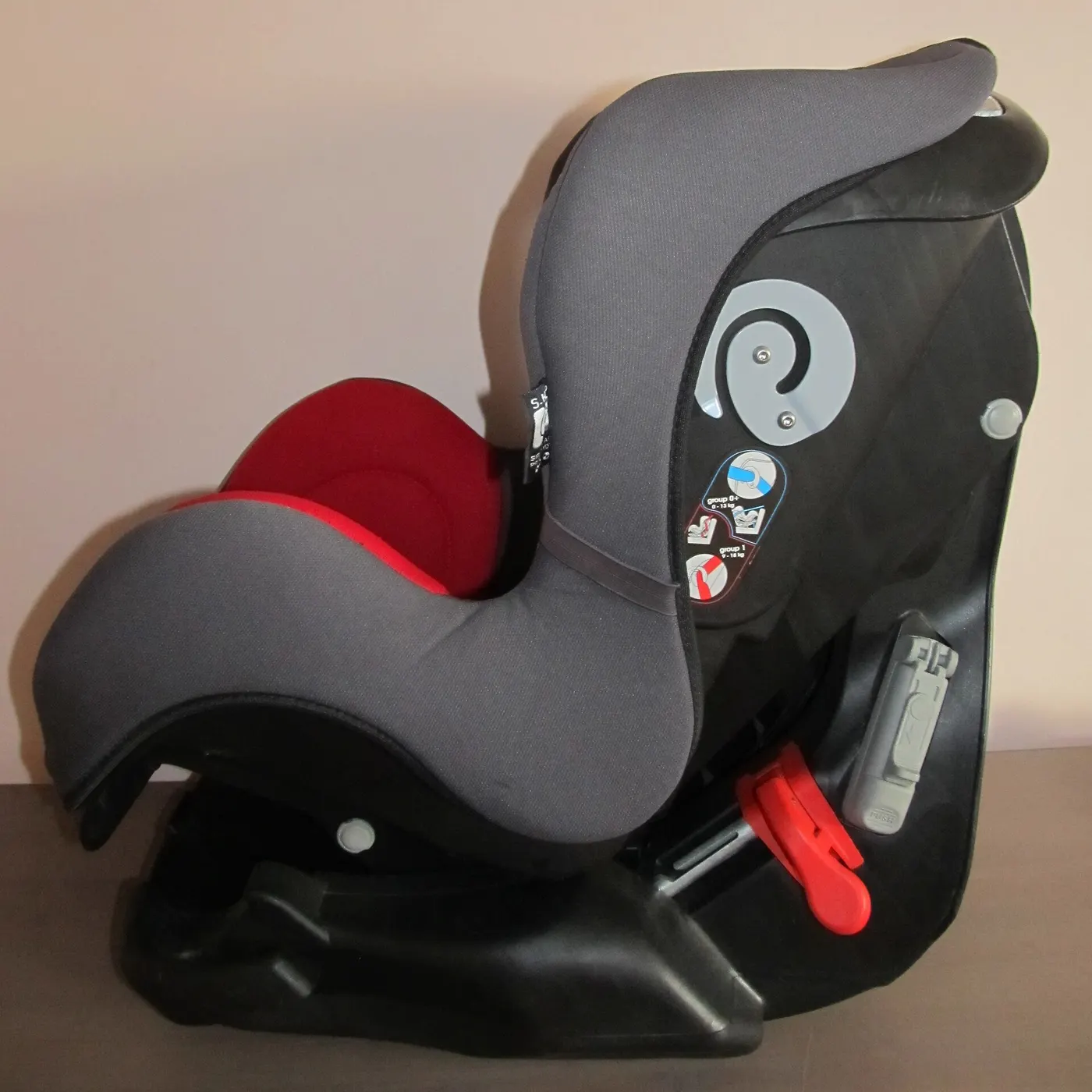
The same guidance sets the stages: rear-facing from birth until age 2 to 4 and as long as possible after that, forward-facing with a harness until at least age 5, a booster until the seat belt fits properly which is typically around ages 9 to 12, and properly buckled in the back seat until age 13.
The fit test at the end of the booster stage is a physical one rather than a birthday. The lap belt should lie across the upper thighs rather than the stomach, the shoulder belt should cross the middle of the chest and shoulder rather than the neck, and the child should be able to sit all the way back with knees bent at the seat edge for the whole journey.

A ten-minute check on anything secondhand
Start with the label. A stroller without a legible manufacturer name, model identification and date of manufacture cannot be matched to an ASTM edition or searched against the recall database, and that alone is enough to pass on it. A car seat without its label and manual is in the same position.
Then search the model in the Consumer Product Safety Commission's recall database, which can be filtered by date range, hazard, product category and manufacturing date, and which records the units affected, the hazard and the remedy offered. This takes 2 minutes and costs nothing.
Then work the mechanism. Fold and unfold a stroller 10 times and listen for the latch seating each time; load the seat and test the parking brake on a slope; pull every harness strap to its limit and look for fraying at the adjuster. Latching mechanisms, brakes and occupant retention are all tested requirements in the standard, which is exactly why they are the three to test by hand.
Before you buy
- Measure between crib slats and confirm no gap exceeds 2 3/8 inches
- Check corner posts stand no more than 1/16 inch above the rail
- Confirm there are no cutouts in the headboard or footboard
- Press the mattress into each corner and confirm there is no gap to the crib side
- Keep the crib bare except for a fitted sheet, and place the baby on their back
- Read the stroller's permanent label for manufacturer, model and date of manufacture
- Match the date of manufacture to the ASTM F833 edition, and search the model in the CPSC recall database
- Test the parking brake loaded, cycle the fold latch 10 times, and check harness webbing for fraying
Questions readers ask
- How do I check slat spacing without a ruler?
- The CPSC describes the 2 3/8 inch limit as about the width of a soda can, so a standard can is the field test: if it passes between two slats with room to spare, the spacing is too wide. A tape measure settles it properly, and the measurement to take is between the slats rather than from centre to centre.
- Why does corner post height matter at all?
- The published limit is 1/16 inch, and the hazard it addresses is clothing catching on the post. A post that stands proud of the rail gives a sleeve, a hood tie or a bib string something to hook over while a child is standing in the crib. Decorative finials on older cribs are the usual way this limit is exceeded.
- Can a baby sleep in a swing if they fall asleep in it?
- The CPSC guidance is to move the baby to appropriate sleep furniture, and it names rockers, gliders and swings as products not intended for sleep. It also states that inclined products should not exceed 10 degrees for infant sleep, which most swings do by design when reclined.
- When can a child stop using a booster seat?
- When the adult belt fits, which the CDC puts at typically ages 9 to 12 rather than at a fixed birthday. The physical test is a lap belt across the upper thighs, a shoulder belt across the middle of the chest and shoulder, and the child sitting fully back with knees bent at the seat edge for the whole journey.
- Is a recall search really worth doing on a new product?
- It takes 2 minutes and the database is filterable by product category and manufacturing date. Recall notices record the units affected, the hazard and the remedy, and products sit on shelves and in warehouses for months after a notice is issued. Matching the model identification on the label is the whole check.
Sources
- Consumer Product Safety Commission — crib safety tips, slat spacing, corner posts, cutouts, mattress fit and mesh size — checked 2026-11-03
- Consumer Product Safety Commission — news release on federal crib safety requirements, slat spacing and 26 inch rail height — checked 2026-11-03
- Consumer Product Safety Commission — business guidance for carriages and strollers, 16 CFR part 1227 and ASTM F833 editions — checked 2026-11-03
- Centers for Disease Control and Prevention — child passenger safety, 2023 casualty figures and seat stages — checked 2026-11-03
Some links on this site can earn us a commission. That does not change which product a guide recommends, and it adds nothing to your price. Advertising is not enabled on this site yet. When it is, ads will be labelled and kept visually separate from the guides.